Chapter 29 Clinical environment
Structured oral examination question 1#
Sterilization
What is the difference between sterilization and disinfection?
Sterilization is the process that destroys all forms of microbial life and is carried out in healthcare facilities by either chemical or physical methods.
What about cleaning?
Cleaning is a physical process that removes contamination.
What forms of sterilization are you familiar with in the orthopaedic setup?
High-temperature sterilization of which pre vacuum type is most commonly used for sterilization of instruments and linen. Low-temperature sterilization, of which ethylene.
How are instruments or linen sterilized?
Instruments and linen are sterilized in a controlled environment called the central sterile supply department (CSSD) that is divided into areas where the following is carried out: following a visual inspection instruments are wrapped in a sterilization wrap or kept in rigid containers or instrument trays.
Can you think of any factors that can affect the efficacy of the sterilization process?
Factors that affect the process are inadequate cleaning beforehand, high residual protein or salt before sterilization, biofilm accumulation instrument design (e.g.
How are sterilization processes monitored?
Chemical indicators that are usually heat- or chemical-sensitiv e inks that change colour when one or more sterilization parameters are present.
Biological indicators are the only process that directly monitors the lethality of a given sterilization process by using commercial preparation of spores. This is a relatively inexpensive mode of monitoring.
How are sterile instruments transported from CSSD to theatres?
Sterile instruments should be transported in covered or enclosed.
Structured oral examination question 2#
Tourniquet use
What is Figure 29.1 demonstrating?
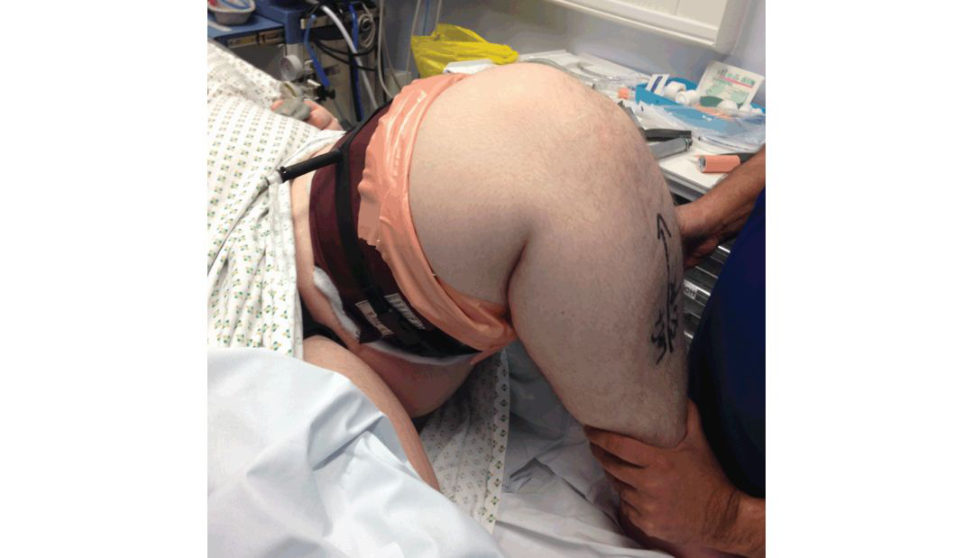
Figure 29.1 Tourniquet.
This picture shows a pneumatic tourniquet with an airline to connect to a pneumatic device.
Can you tell me how you correctly size a tourniquet and select inflation pressure?
A correctly sized tourniquet should be at least one and a halftimes the circumference of the limb or proportional to the leg or arm diameter. In the upper limb, the inflation pressure should be 50 mmHg higher than the systolic pressure while in the lower limb the pressure should be double.
When would you not use a tourniquet?
if there is a previous history of tourniquet problems or in severe peripheral vascular disease.
What forms of exsanguination are there when using a tourniquet?
There is either exsanguination by elevation or expression. Inpatients with venous thromboembolism, infection.
What complications can be encountered when using tourniquets?
Local complications can be pain or compression neuropraxia, skin pressure sores, postoperative swelling or compartment syndrome.
What is tourniquet paralysis syndrome?
This a flaccid motor paralysis with sensory disturbance usually affecting pain sensation rather than temperature and is caused by cuff pressure and not ischaemia.
How is this different to post-tourniquet syndrome?
Post-tourniquet syndrome is are perfusion injury and is due to ischaemia after release of the tourniquet.
What should you do about the tourniquet if you are performing a long operation?
The tourniquet should be deflated for at least 20 minutes before re- inflation.
Structured oral examination question 3#
Sutures
What type of sutures do you use in your practice?
I use absorbable sutures like vicryl or non-absorbable such as prolene.
What are the differences between vicryl and prolene?
Vicryl is a form of braided suture and.
What is the effect of braiding?
The effect of braiding is to increase the friction coefficient.
Are there any disadvantages of using braided sutures?
Braided sutures have an increased risk of promoting infection duet o capillarity, as the interstices between fibres can facilitate the spread of pathogens along the fibre and thus to the placement site.
Can you give me examples of approximate resorption and wound support times for common sutures you use?
Monocryl: wound support 20 days Resorption 90 –120 days VICRYL : wound support 30
Structured oral examination question 4#
Electrosurgery
What does Figure 29.2 demonstrate?
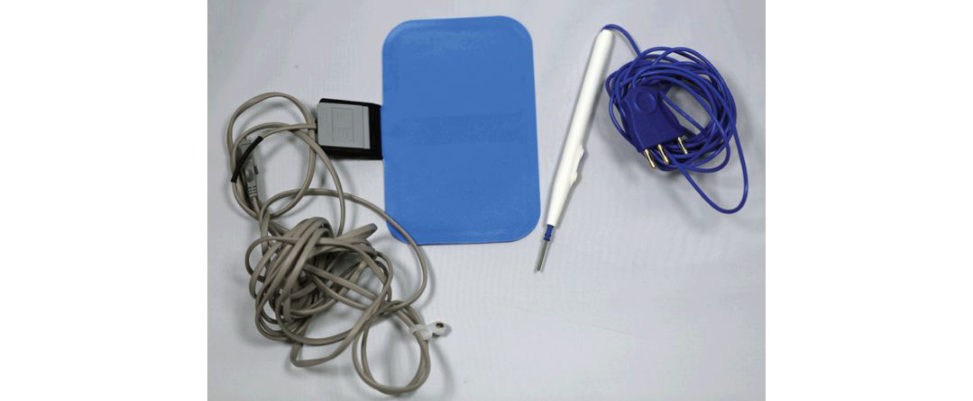
Figure 29.2 Monopolar diathermy.
This shows monopolar diathermy and a return electrode.
How does monopolar diathermy work?
High-frequency (400 kHz–10 MHz) AC current passes between an active electrode and an indifferent electrode or plate. As a result, it avoids damage through passage of current through surrounding tissue.
How is this different to bipolar diathermy?
In bipolar diathermy the passage of high-frequency AC current is passed from the.
Are there any contraindications tousing diathermy?
Although there are no absolute contraindications tousing diathermy, care should be exercised when using diathermy inpatients with pacemakers (use bipolar diathermy only) and avoidance of application of return.
How does diathermy differ to radiofrequency ablation?
Radiofrequency ablation is a procedure in which the electrical conduction system of the heart, tumour, or other dysfunctional tissue is ablated using the heat generated from medium frequency alternating current (350–500 kHz).
Structured oral examination question 5#
Infection control
What does Figure 29.3 show?
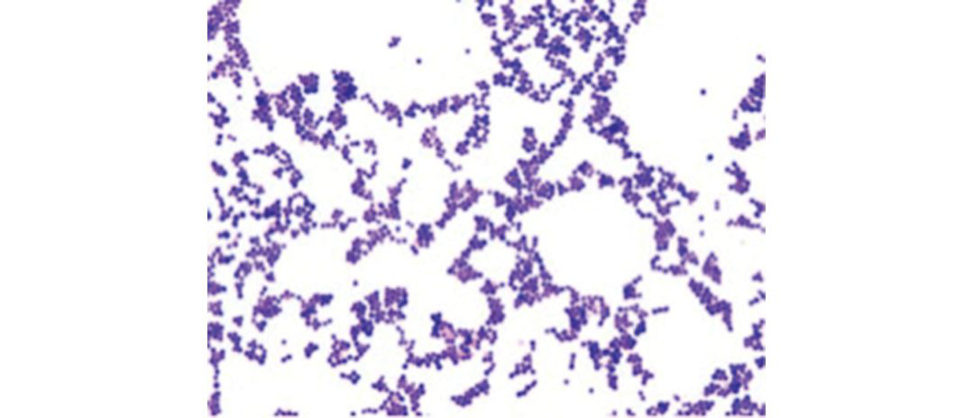
Figure 29.3 Gram-staining Gram-positiv e cocci.
This is a slide of Gram-positiv e cocci demonstrated on Gram staining.
How is a Gram stain performed?
Gram staining initially involves staining with crystal violet solution, then fixing with iodine solution and then finally washing with alcohol.
Can you give me some examples of how antibiotics work?
Antibiotics can either be bacteriocidal or bacteriostatic or have mixed properties Penicillins cephalosporins and glycopeptides like vancomycin or teicoplanin inhibit cell wall synthesis.
Can you explain to me how resistance to antibiotics develops ?
Resistance can be intrinsic, where bacteria have the inherent ability to alter properties such as altering the target site or enzyme.
What is MRSA?
It is a Gram-positiv e bacterium that acquires resistance to methicillin PBP2a.
How do you prevent and treat MRS Ain your unit?
It is prevented in my unit through an MRSA screening protocol and treated by an MDT approach inline with an infection control team and microbiologists. If screening swabs.
What would you do if you had four consecutive total hip replacement patients that became acutely infected whilst still inpatients?
This is a clinical governance emergency. This would involve a multidisciplinary team, barrier nursing and appropriate antibiotics instituted. A commift ee should be set up in order to investigate the outbreak responsible for reporting a t a national le vel. This should involve the microbiologist and infection control team. Theatre suite efficiency and ward cleanliness should be investigated particularly on whether or not ring-fencing protocols have been adhered to.
What will you do if you find out you YOURSELF as the surgeon has MRSA?
Firstly it is worth noting that it is likely that many clinicians will be carriers. I would take an immediate opinion from my infection control team in the trust in order to inform them and to take their advice. Non-clinical work may sometimes be possible, but this is normally subject to local protocol.
Would you tell your patients?
In keeping with my duty of candour, I would perform an audit of all surgical cases performed in order to trace any potential MR SA infections contracted postoperatively. Should any cases be identified then these should be discussed as part of a multidisciplinary approach involving microbiology advice.
Structured oral examination question 6#
Theatre design
You are responsible for designing new orthopaedic theatres in your hospital. How would you go about doing this?
The theatre suite should be located close to the Emergency Department wards and the Radiology departments. The zones are there so that there are defined boundaries where specific activities can take place in the theatre environment. Outer Zone: Clean Zone: Disposal Zone: Through the backdoor to the disposal area.
What other structural aspects of design are important?
Consideration should be given to the walls, floor and doors. Doors should open outwards as approximately 2 m3 of air is moved when a hinged door is opened. There is a minimal positive pressure gradient of 15 Pascal between the operating room and outside areas which aids the direction of flow of air if the doors open outwards.
In considering the design of theatres what environmental factors are considered?
Lighting , temperature, humidity and ventilation. Lighting should c ast minimal shadow, should not generate heat and should be at least 40,000 lux. Modern-day LED lights are 120,000 lux. The temperature in theatres should be 18–23°C. This is a compromise between what the theatre staff feel comfortable in and the ideal temperature for the patient which is about 26°C. Humidity should be 30–60%.
Structured oral examination question 7#
Ventilation
What forms of airflow in theatre are you familiar with?
Plenum is airflow down a pressure gradient. This type of airflow is subject to turbulence and eddies. In a plenum system there are 15–25 air changes per hour. This airflow essentially moves particles floating in the airstream away from the sterile field into the return ducts and filtration systems where they can be disposed of. For airflow to be laminar the velocity of air must be 9 m/s. In a laminar flow system there are about 200 air changes per hour.
What types of laminar airflow systems are there?
Laminar airflow can be horizontal, vertical or newer systems in which the airflow takes the form of an inverted trumpet (exponential flow). Because of efficiency of the ex-flow system they can function a t fewer air changes per hour than the traditional laminar flow systems.
How is ultraclean air achieved in theatres and how is it monitored?
Filtration systems are usually monitored regularly where a 1 m3 sample of air is obtained through a (Casella) slit sampler and introduced over an agar plateLess than 10 colony forming units/m3 (CFU/m3) defines ultra-clean air. In the laminar system around the theatre table it is < 10 CFU/m3, but in the periphery of the theatre it should be < 20 CFU/m3.
What is the evidence for the use of laminar airflow in theatre?
(MRC trial) showed a reduction in deep sepsis by 50% with ultraclean air systems (3.4% down to 1.7%). In 2011 the results from the New Zealand joint registry suggested no reduction of early deep infection rate inpatients undergoing both total hip and total knee arthroplasty.
In fact, the infection rate was significantly higher in hip hemiarthroplasties when performed in a laminar airflow theatre.
Structured oral examination question 8#
Theatre etiquette
Does the number of people in theatre matter?
showed that the bacteria count in the operating room air increases 3–4-fold in a theatre with 5 people compared to an empty room.
So, what is ‘entrainment’ and how can this be prevented?
Entrainment refers to the situation which arises when theatre personnel or equipment disrupt the laminar airflow and the air (and particles) is diverted towards the operative field. The second method to prevent entrainment is the use of the ex-flow system via its inverted trumpet effect.
What are your views on scrubbing?
Chlorhexidine decreases the bacterial count by 99% compared to povidone iodine, which is 97%. Hot water should not be used as it decreases the antimicrobial powers of the antiseptics.
What should a surgeon wear in theatre to reduce infection?
Goretex prevents particles greater than 0.2 μm, but is expensive. Therefore, synthetic hydrophobic, non-woven, disposable clothing made from spun-laced polyester pulp with mesh size much less than 80 μm is effective and more comfortable and convenient to wear.
Structured oral examination question 9#
Peri operative bleeding
What does Figure 29.4 show, and can you tell me how peri operative bleeding can be influenced by some common medication with reference to this pathway?

Figure 29.4 Coagulation cascade.
This demonstrates the coagulation cascade. Aspirin inactivation of cyclo oxygenase (COX) enzyme. inhibition of hepatic enzymes for vitamin K (factors II, VII, IX, X).
What is clopidogrel?
Clopidogrel is an irreversible platelet inhibitor with a half-life of 5–7 days. It is used in cardiac conditions.
How does tranexamic acid work? What is its role?
Tranexamic acid inhibits fibrinolysis by blocking plasmin effect on fibrin. Tranexamic acid lowers the rate of transfusion without increasing the rate of venous thromboembolism. For IV administration the patient requires normal renal clearance and no history of cardiac surgery or venous thromboembolism.
What other strategies are available to reduce peri operative blood loss inoperations such asT KAs?
Although tranexamic acid is the most important, other strategies exist: Avoidance of tourniquet during the surgery – as this will result incontinuous cautery of bleeding during surgery. It is noted that the release of the tourniquet at the end of the procedure may cause a reflex hyperaemia which may increase the blood loss.
References
Hooper GJ, Rothwell AG, Frampton C, Wyatt MC, et al. Does the use of laminar flow and
Zealand Joint Registry. 2011;93:85–90.
Ultraclean air and antibiotics for prevention of postoperative infection – a multic entre study of 8,052 joint replacement operations .
McGovern PD, Albrecht M, Belani K, et al. Forced-air warming and ultra-clean ventilation do not mix
Bone Joint Surg (Br). 2011;93(11):1533–1544.
Nicolay CR. Hand hygiene: an evidence-based review for.
Tourniquet use and its complications in Norway.
2006;88B:1090–1092.
Pinder EM, Boti leA, Aylin P, Loeffler MD, et al.
An observational study of trauma in England. J.
Rifter MA, Eitzen H, French ML, Hart JB, et al. The operating room environment.