Chapter 9 General principles and fracture biomechanics
Introduction#
Fracture biomechanics can be tough-going for most candidates and yet it is definitely an A-list topic.
Textbook chapters can be too complicated and detailed to understand whilst short note sections may appear incomplete as biomechanical assumptions have not
We hope this chapter uncomplicates a difficult area of the syllabus that a lot of candidates find offputing.
Structured oral examination question 1#
IM nail biomechanics
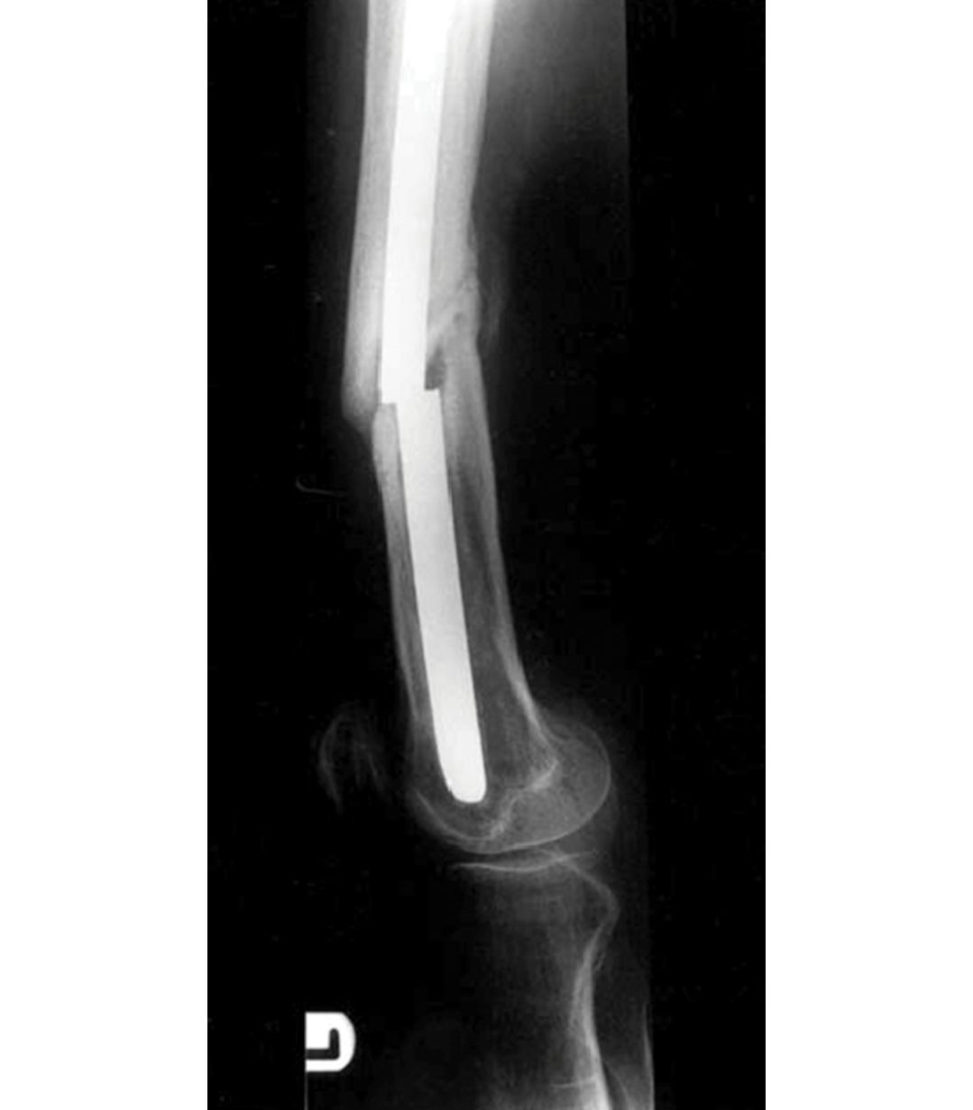
This is a radiograph of a broken femoral nail that was used to fix a distal femoral shaft fracture (Figure 9.1). How can you prevent nail breakage? CANDIDATE 1 : I would insert the largest diameter solid nail that is available for use.
Not a good start. The answer isn’t particularly well thought out and is not scoring the candidate any marks.
Why would you use a solid nail? Most nails used in orthopaedics are hollow.
Because a solid nail will be stronger than a hollow nail. This is continuing on with a poor choice
What do you mean by the term ‘stronger’?
Strong is the ability of a material to resist deformation. This is an incorrect definition and the vi vais going nowhere.
How does this relate to ultimate tensile strength (UTS)?
Strong is an imprecise biomechanical term. This will then lead onto discussions about area and polar moments of inertia, the biomechanical benefits of using larger-diameter nails for long bone fractures, the solid versus hollow nail dialogue, benefits of IM reaming, etc. Another road to journey down is patient factors that could predispose to nonunion and eventual nail breakage(smoking, alcohol, malnutrition etc) (Score 4.) CANDIDATE 2: An unstable fracture pattern (segmental or comminuted) or the use of a small unreamed diameter nail increases the risk of nail breakage. Early weight bearing with delayed fracture healing increases the time over which cyclic stress may act to cause fatigue failure and nail breakage.
Excessive impaction during nail insertion duet o under-reaming of the medullary canal may also weaken the nail.
Intramedullary nails rarely break when no locking screws are used. Statically locked nails can produce high concentrations of stress at the proximal or distal end of the nail, predisposing it to breakage.
(Score 6.)
What do you mean by fatigue failure?
Failure of a material with repetiv e loading below the ultimate tensile strength.
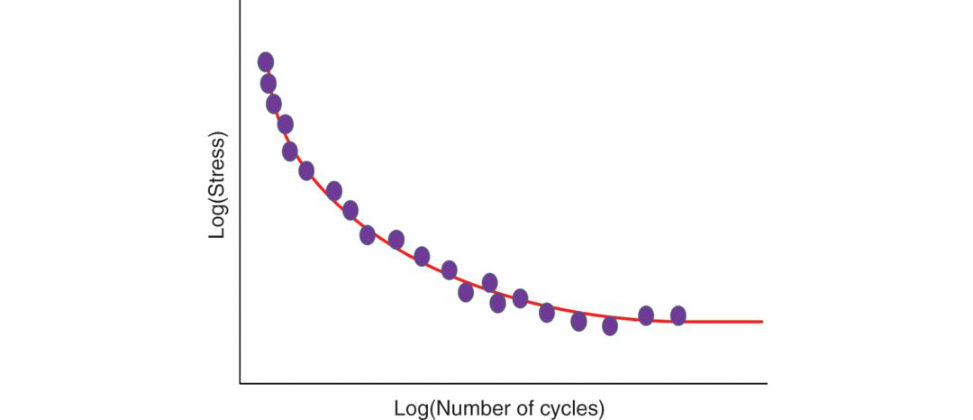
What do we mean by S-N curves?
An S-N curve gives information about the number of cycles a material can endure for a given stress level.
Can you drawout an S-N curve?
(Figure 9.2)
What makes fatigue failure more likely?
In the presence of stress risers such as a hole, a sharp edge, an indentation, notch or scratch, the loads
Why?
Crack propagation.
What do you mean by this?
Sorry, I am not sure. Score 6. For a score 8: The applied stress concentrates on residual material beneath a stress riser and means the number of cycles to failure is much lower than the fatigue strength. Using a stainless steel rather than titanium nail (higher Youngs modulus) but long list of pros and cons for each material.
Figure 9.1 Lateral radiograph of left distal femur demonstrating a broken femoral nail.
Figure 9.2 S-N curve.
Structured oral examination question 2#
Area and polar moment of inertia
What do we mean by the terms second moment area and polar moment of inertia?
The further away the material is from the centre of a beam, the greater its bending stiffness. The polar moment of inertia applies to a cylindrical structure and its ability to resist torsion.
How do the second moment area and polar moment area differ between a solid and a hollow nail?
For a solid nail the second moment area or second moment of inertia is directly proportional to the fourth power of the radius. I = π(rO4 – rI4)/4 Nail wall thickness is equal to the difference between r0 = outer radius and r1 = inner radius.
Controversial topic
The assumption that if a nail has a thin wall then the inner radius is roughly equal to the outer radius,
Hollow orthopaedic implants do not approximate to rO3.
In engineering, approximations are made for ‘thin’ cylinders, which is when the inner radius (r1)
approaches the outer radius (r0). The rO4 – rI4 term approaches rO3 as rOrI, hence the approximation.
The wall thickness of a hollow nail must be optimal to be able to withstand bending stress and avoid sudden failing by buckling (local concentrated deformations). The implant also starts behaving as a curved sheet rather than a hollow cylinder .
A Synthes 13 mm nail (6.5 mm radius) has a 1.2 mm wall thickness. r0 = 6.5 mm, rI = 5.3 mm (which is
So (rO4 – rI4) = 1785 – 789 = 996. 996 is 3.6 × 275, so to estimate a hollow nail to rO3 is a 360% underestimate which is quite significant.1
For a solid nail the polar moment of inertia (polar moment area) varies with the fourth power of its radius.
Jo = πr4/2
For a hollow nail the polar moment of inertia varies with the fourth power of the outer radius minus the inner radius.
Jo = π(rO4 – rI4)/2
Which type of nail, solid or hollow, biomechanically do we prefer to use?
A hollow nail is more efficient as less material can be used for equivalent values of bending and torsional rigidity.
Why?
The further the material is spread away from the neutral axis of the nail, the greater
Why are spiral fractures of the tibia more common in the lower third of the tibia even though the cortex is much thicker there?
Under a specific load the lower third segment will deform more than the upper segment of the tibia. The further amate rial is distributed away from the neutral axis of the structure, the greater the polar moment and therefore greater strength and rigidity against torsional stress.
(For score 8 candidates.)
What about the bending and torsional rigidity of a hollow nail with an open section?
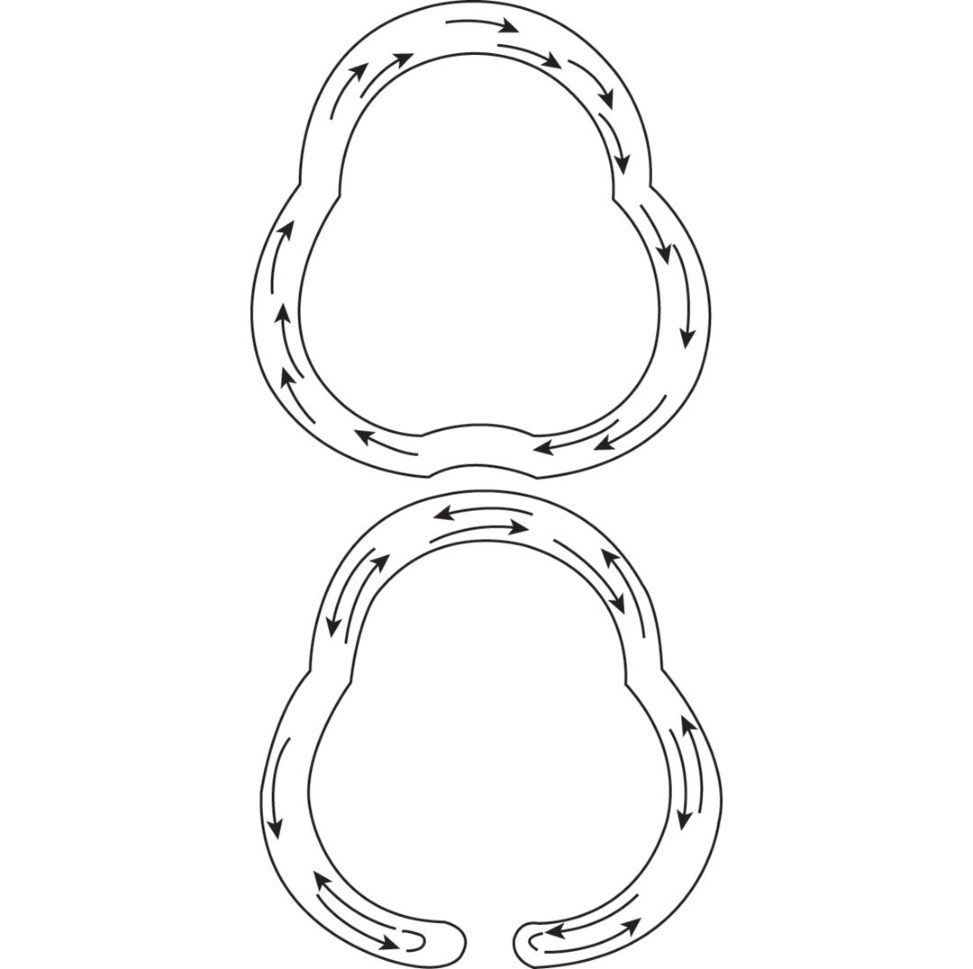
Stress is transmift ed uniformly through the entire thickness of the cross-section of a closed-section hollow nail without any change indirection. The reis a change is stress direction in an open nail when its gap is reached with a significant fall in the magnitude of polar moment (Figure 9.3).
What about differences between the cross-sectional shape of a nail?
A cloverleaf cross-section nail improves torsional and bending rigidity compared to a round cross-section .
Why?
I am not sure.
Figure 9.3 With the open-section nail the reis reversion of the direction of torsional stress as shown by the arrows. In a closed hollow nail, the nail stress lines are in the same direction because of the continuity and therefore the nail is stronger against torsion.
Structured oral examination question 3#
IM nail
What does the picture show (Figure 9.4)?

This is a clinical picture showing an intramedullary nail. They are usually made of titanium. Be able to describe the typical features of an IM nail.
How does an IM nail function?
IM nails stabilize a fracture by acting as internal splints with load-sharing characteristics.
What do we mean by an internal splint?
Splintage is defined as a construct in which micromotion can occur between bone and implant, providing
Do nails always act as a load-sharing device?
It depends on how it is used. Candidate waffle.
How is it used?
[Silence ...] In more comminuted fracture patterns that are not axially stable, a nail will have to transmit all the forces applied to the limb, so-called load-bearing.
Which is stiffer, a solid or a hollow nail?
The bending stiffness of a cylindrical cross-section is proportional to the fourth power of its radius as described by the second moment of area. If, however, a constant volume of material is used for construction of an IM nail of fixed length, then the use of a hollow nail would allow a greater outer radius to be used, resulting in a stiffer nail.2
When plating a fracture what factors do you need to consider?
I would need to decide if I want to achieve primary or secondary bone healing.
If the fracture was significantly comminuted I would ideally choose to plate in bridging mode
Simple fractures could be treated with interfragmentary compression.
Ideally, plate position should be on the tension side of the fracture. I would need to decide the length of plate itself, the number and relative position
The plate length should be 2–3 times higher than the overall fracture length in comminuted fractures and 8–10 times higher in simple fractures.
The plate screw density should be kept below a value of 0.5, indicating that less than half of the plate holes are occupied by screws.
Such a construct will fail if one screw breaks due to overload or if the screw loosens, so it is generally advised to add another screw to each side of the fracture construct.
Plating offers two different fixation concepts – splinting and inter fragmentary compression.
Comminuted fractures are best treated using a splinting technique, because local bone and soft tissue de vascularization can be minimized;
When nailing the position, the length and diameter of the nail as well as the position of the locking bolts are more orless
What is the working length of a plate?
The working length of a plate is defined as the distance across a fracture site between the two nearest points
How is the working length of a plate altered?
which increases a plate’s construct stiffness Screws placed further from the fracture site increase the working length and produce a less-stiff construct that permits more motion a t the fracture gap.
What problems may arise if screws are placed too close to the fracture site?
Placing screws further from the fracture site can better distribute the stress the plate experiences and decrease the risk for plate fatigue failure.
The addition of more than three screws per fragment does not significantly impact on a plate’s construct stiffness in axial loading.
Why do we want to avoid over-torqueing of screws?
Over-torqueing of the screws should be avoided during insertion. The screw head can be destroyed.
What else?
As a screw is inserted into bone, the screw head compresses the plate against the bone with a force proportional to the torque applied to the screw. Although pull-out strength is related to the depth of the screw thread and quality of the bone, stripping the screw reduces the pull-out strength of the screw by more than 80%.
Why do we retighten screws before closure?
Before wound closure, all screws should bere tightened to allow time for stress relaxation of the screw–bone interface.
Figure 9.4 Titanium IM femoral nail.
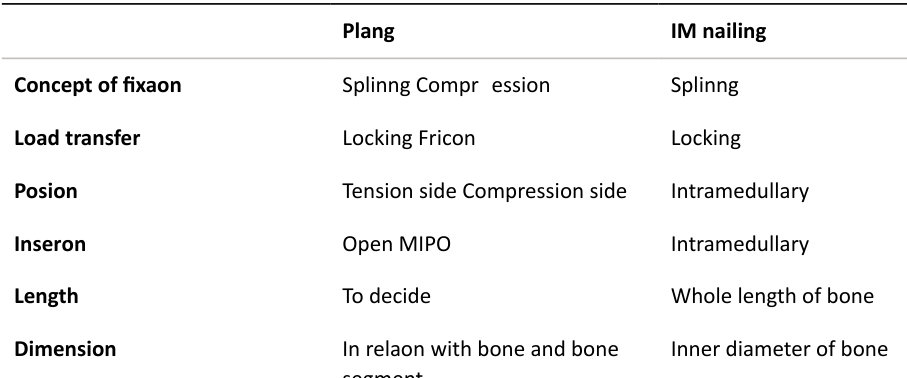
Table 9.1 Characteristics of fixation.
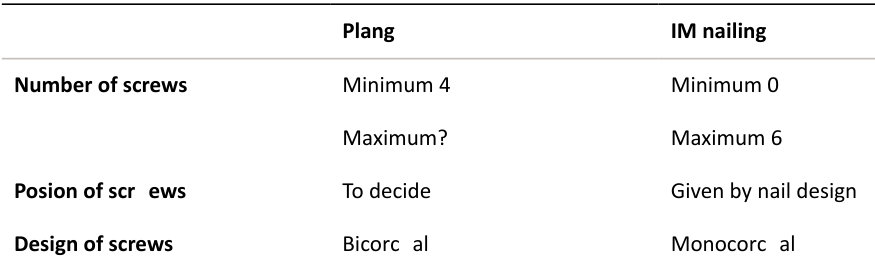
Bi cortical
Self-tapping
Self-drilling
Standard cortical
Locking
Structured oral examination question 4#
Biomechanics IM nail
What is the working length of a nail?
More simply, it is the distance between the two points on either side of the fracture where the bone firmly grips the metal. Thus, working length is the unsupported portion of the nail between the two major bone fragments and reflects the length of a nail carrying the majority of the load across the fracture site.
What is the relationship between the working length of a nail and bending rigidity?
The bending rigidity of a nail is inversely proportional to the square of its working length.
What about torsional rigidity and working length?
If all else fails, a shorter working length means the greater the bending and torsional rigidity of a nail, i.e. a stronger fixation.
What factors affect working length?
When the bone bends at the fracture site the nail may become fixed to the bone by 3 point fixation. Type of fracture (fracture pattern) and if the fracture is reduced. Interlocking. Reaming. A nail has a shorter working length inbending with fixation of a transverse fracture than when used to stabilize a comminuted fracture.
What affects bending rigidity?
Bending rigidity is affected by: 1. 2. Structural properties. (a) Length. (b) Second moment area (SMA) of the nail, which is a variable that describes the spatial distribution of amate rial within a structure.
For a solid circular nail, the bending rigidity is proportional to the fourth power of the nail’s radius.
SMA = π.r4/4
For a hollow nail the bending rigidity is very roughly proportional to the third power of the nail diameter.
Are you sure (see above)?
It is more accurate to say the bending rigidity is directly proportional to the fourth power of the outer radius minus the
What affects torsional rigidity?
1. 2. Structural properties. As lofted nail has a torsional rigidity of 1/50 that of a non-sloft ed nail.
And?
A nail with sharp corners or fluted edges resists torsional forces to a greater degree than a smooth-walled nail.
What is the difference between second area moment and polar moment for a nail?
The second moment area and polar moment area represent the relationship between bending and torsional rigidity of a nail and its cross-sectional dimensions. This may lead on to the examiners asking about the differences in second area moment and polar moment for a solid and hollow nail (see above).
What happens to polar moment of inertia when a nail has a slot?
The polar moment of inertia is greatly reduced.
What about length of the nail, how does that affect bending rigidity?
The length of the nail between the forces working to bend it determines the length of the moment arm and
How is bending and torsional stiffness related to working length?
The bending stiffness of a nail is inversely proportional to the square of its working length. The torsional stiffness is inversely proportional to its working length.
How does medullary reaming affect working length?
Medullary reaming prepares a uniform canal and improves nail–bone fixation towards the fracture, thus reducing the nail’s working length.
What do you mean by stiffness?
Stiffness is defined as the slope of the curve in the elastic range on a stress–strain curve.
Are you sure?
Yes. Stiffness is defined as the slope of a force versus displacement graph. Elastic modulus is the corresponding slope, but of a stress versus strain graph.
What material are IM nails made of?
They are made of either titanium or stainless steel. IM nails can be solid or hollow.
How can we reduce the stiffness of a nail?
One way of reducing stiffness ist o put a longitudinal slot in the wall of a nail. Very stiff nails may damage the bone if there is any discrepancy between the shape of the nail and that of the bone.
What factors alter a nail’s axial, bending and torsional rigidity?
This can be divided into material and structural properties Parameters include cross- sectional geometry,
Structured oral examination question 5#
IM nails
Initial questions on area and polar moment of inertia, bending and torsional rigidity (see above).
How does the presence of a slot affect bending and torsional rigidity of a nail?
The presence of a slot reduces both the bending and torsional stiffness of a nail.
Why do we uses lofted nails?
It makes the nail easier to insert.
What else?
Err ... Bone tissue exerts an equal and opposite force on the nail (Newton’s third law). EXAMINER : What about hoop stresses? Sorry? Hoop (expansion) stresses are generated in the bone when an IM nail is inserted. If hoop stresses are too high they can cause comminution or splintering of the bone.
What is the difference between stiffness and rigidity?
[Long silence ...] Sorry, I don’t know. Rigidity and stiffness are very similar concepts often used interchangeably to denote overall performance of a structure. Depends on amate rials stiffness and geometry construct. Rigidity incorporates both the type of material and its shape and size.
Why do we use interlocking screws (bolts)? What function do the y perform?
Interlocking screws help control torsion and axial loads placed on the nail. They provide rotational and longitudinal stability.
Historically, why were they introduced?
The use of interlocking screws expanded the indications for use of IM nails to include more
What are the disadvantages of using interlocking screws?
The holes in the nail act as stress risers. The weakest part of the nail to fatigue is a t or just proximal to the most proximal distal locking screw. There is an increased rate of nail breakage if the fracture is within 5 cm of these screws, or if the screw hole closest to the fracture is left unfilled. The closer the fracture is to the distal locking screws, the less cortical contact the nail has, which leads to increased stress on the locking screws and greater chance of screw breakage.
When nailing a long bone, how do you decide on how many locking screws to use?
The number of interlocking screws used is based on fracture location, amount of fracture comminution, and the fit of the nail within the canal. Midshaft transverse femoral fractures have the greatest fixation stability because of isthmic cortical contact.
How are locking screws (bolts) different to other screws used for fracture fixation?
The screw functions to reduce torsional stresses acting on the nail and is not designed to maximize pull-out strength.
What may occur if you place too many screws in multiple planes through a nail?
An IM nail allows fracture healing with relative stability even if a nail is statically locked. Minor movements occur between the nail and screw even in a static mode of nail fixation.
What is the biomechanical effect of the orientation of the locking screw?
Distally, however, there is litile difference. In the femur, studies suggest no difference in biomechanical behaviour with locking screw orientation.
What effect does multiple locking screw breakage have on fracture stability?
Premature failure of locking screws especially with unstable fracture patterns may lead to angulation shortening, malunion and IM nail migration.
How can you reduce the risk of locking screw failure?
Compared tousing a smaller screw a larger screw diameter increases fatigue resistance. A stainless steel screw has a different fatigue life than a titanium screw. Stainless steel is more ductile than titanium. Inserting a screw incorrectly can result in surface defects as well.
Why not insert the largest locking bolt possible to reduce the risk of locking bolt failure?
The largest diameter of locking bolt that can be used is limited by the diameter of the nail. Nail hole size should not exceed 50% of the nail diameter. Interlocking screws undergo four-point bending loads, with higher screw stresses seen at the most distal locking sites (Figure 9.5).
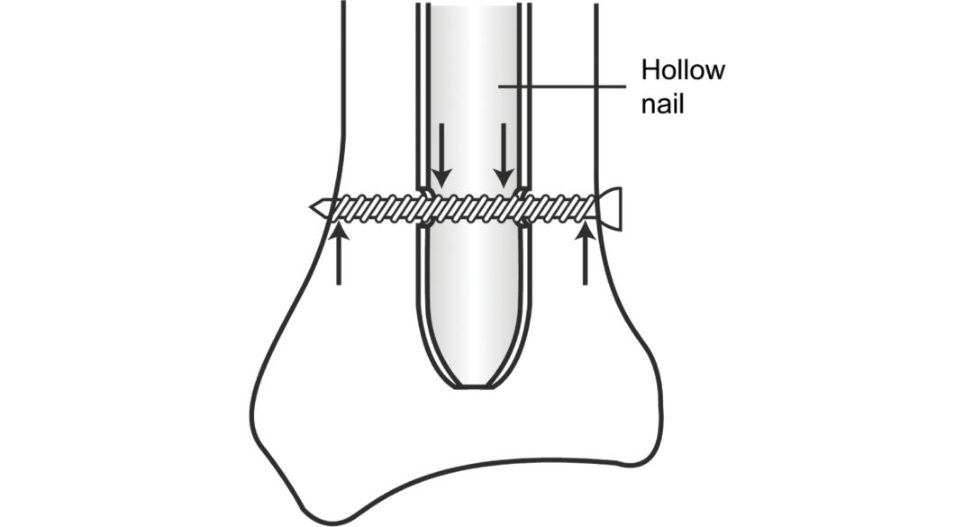
Figure 9.5 Four-point loading on distal interlocking bolts. Four-point loads (arrows) acting on a distal interlocking screw.
Structured oral examination question 6#
Plates
The candidate is shown a laminated picture of a plate and asked to describe.
What is this?
This can be difficult to answer without having a pre-structured approach to the question. Think in terms of: 1. 2. Width of plate (small, narrow, broad). 3. Shape of screw holes (round slots, oval slots). 4. Surface contact characteristics (L CP). 5. Intended site of application condylar plate). 6. 7.
What happens to the moment of inertia if you place a rectangular beam 2 × 4 on its edge rather than on its side?
It is ‘stronger’ inbending when placed on its edge (2ʹʹ side) than on its flat (4ʹʹ) side, yet its cross-sectional area remains constant. A 2ʹʹ × 4ʹʹ beam on its edge has an area moment of inertia f our times greater than on its side and thus demonstrates a fourfold increase in rigidity. The practical relevance is that when fixing a fracture, the bone surface chosen to apply a plate can affect mechanical construct stiffness. The bending stiffness of a bone plate is proportional to the thickness of the plate to the third power, whereas the bending stiffness is directly proportional to the width or elastic modulus of the plate. Therefore, changing the plate thickness has more effect upon stiffness than changing the plate width or material. A plate made of one material can have significantly different properties depending on its width, length, thickness and position of holes.
This is expressed as the base (b) times the height or thickness cubed over 12.
Ia = bh3/12
Bending stiffness = EI a, where E is Young’s modulus, Ia second moment of area.
Candidates need to understand how the properties of a plate can change depending on its position on
If you are plating a humerus fracture when would you use a 3.5-mm or 4.5-mm thickness plate?
Therefore, the bending stiffness of a 4.5-mm plate will be more than twice the bending stiffness of a 3.5-mm plate (3.5 = 42,875, 4.5 = 91,125). The 4.5-mm plate is more staggered for screw placement compared to the 3.5-mm plate, which has a narrow area for screw insertion. This reduces the risk of postoperative fracture. The bone shape of the humerus is not flat and not plate-friendly and it can sometimes be difficult to fit a 4.5-mm plate onto the humerus. However, for examination purposes candidates should err on the side of caution and suggest usage of a 4.5-mm plate.
What causes a bone to break after fracture fixation?
There are two mechanisms. That is why some surgeons prefer to leave the last screw hole in a plate empty. This is particularly concerning if the end of the plate is in a high-stress region such as the subtrochanteric part of the femur. In this situation a longer plate should be used to bypass the high-stress area, especially if bone quality is poor.
What do we mean by working length of a plate?
The distance between the proximal and distal screw in closest proximity to the fracture is defined as the ‘working length’ of the plate.
Why is working length important?
Plate working length has been shown to influence construct stiffness, plate strain and cyclic fatigue properties of the plate.
What are the principles of plate fixation?
The principle is the conversion of tensile forces to a compression force on the convex side of an eccentrically loaded bone. This is achieved by placing a tension band (bone plate) across the fracture on the tension (or convex) side of the bone. The plate should be fixed to the tension side of a long bone to avoid fracture gapping. Plate stresses are significantly increased by gapping at the fracture site and may lead to fatigue failure of the plate. Torsional and bending stiffness of a fracture construct can be significantly increased, and therefore, plate strain reduced, by increasing the length of the plate itself.
What about leaving a fracture gap opposite the plate?
As long bones are subjected to eccentric loading, a plate applied to the outer (convex) side counteracts tension forces and provides rigid internal fixation.
What happens if a plate is applied to the tension cortex, but the opposite cortex is defective?
The defective cortex cannot resist compression and the plate will undergo bending stresses and fail under axial load.
How do plate length and screw number affect the biomechanical stability of a plated construct?
The literature is slightly confusing in how plate length and screw number affect the biomechanical stability of a plated construct. Concerns that the plated construct would not provide sufficient construct stiffness and fracture rigidity compared with fixation using shorter plates and more screws have not been realized.
What are the biomechanical differences between an IM nail and a plate?
Start off by first mentioning the function of both an IM nail and a plate . A nail’s cross-section is round, resisting loads equally in all directions, where asa plate’s cross- section is rectangular, resisting greater loads in one plane compared to another (Figure 9.7). The primary function of the plate is to maintain alignment as an internal splint, and to create compression between the fracture ends such that bone can transfer some of the applied loads itself. A compression plate, tension bandora lag screw does this by generating compression across the fracture.
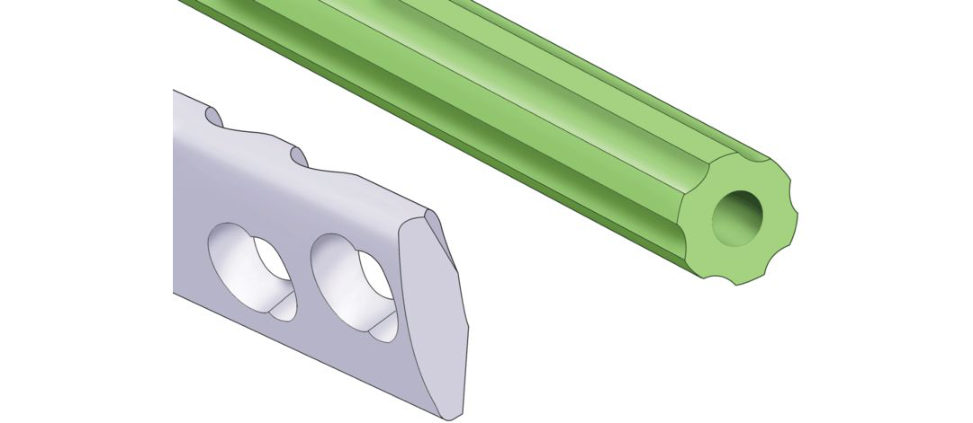
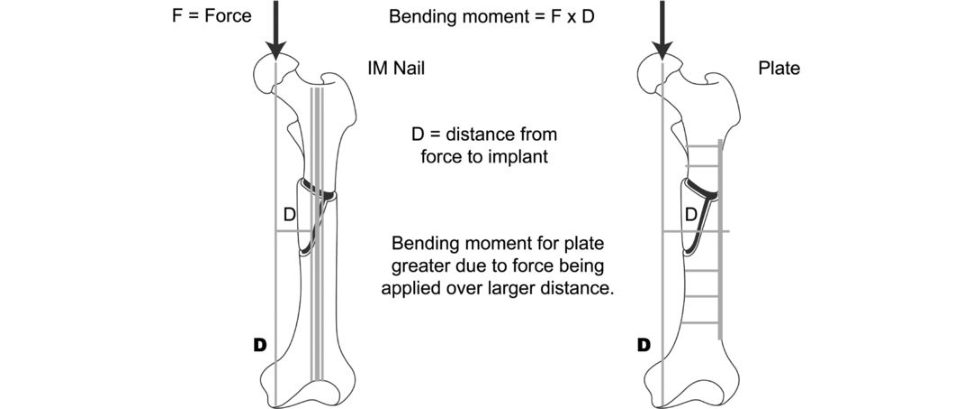
Figure 9.6 Biomechanical differences between a plate and IM nail. Compared to an IM nail the bending moment (Force × Distance from force to implant) for a plate is greater due to the force being applied over a larger distance.
Figure 9.7 Biomechanical comparison of plate vs. IM nail. A nail’s cross-section is usually round, resisting loads equally in all directions. A plate’s cross-section is rectangular, resisting greater loads in one plane vs. the other.
What factors contribute to the overall biomechanical profile of an IM nail?
Sorry? Several factors contribute to the overall biomechanical profile and resulting structural stiffness of an IM nail. These include: Material properties: most nails are made from either stainless steel or titanium. Cross-sectional shape . Nail diameter affects the bending and torsional rigidity of a nail. A larger diameter nail with the same cross-section is both stiffer and stronger than a smaller one. Diameter curves. Nails are contoured to accommodate IM curvature of long bones. Tibial nails have an 11° bend in the AP direction a t the junction of the upper third and lower two-thirds. Length and working length (see previous questions).
What are the benefits of reamed nails?
Reaming allows the insertion of a lar ger-diameter nail that provides more rigidity inbending and torsion.
Reaming increases the contact area between the nail and cortical bone.
You mentioned IM nails being curved. What is the reason for this?
IM nails are contoured to accommodate the curved intramedullary canal of a long bone.
Anything else?
A straight nail if inserted into a curved intramedullary canal will bend and produce stresses
Anything else?
A femoral nail is curved in an AP direction to conform to the curvature of the medullary canal.
What happens when you insert a femoral nail into the medullary canal?
The nail must bend somewhat to fit the curve of the intramedullary canal. An axial insertional force is necessary to insert the nail and this insertional force is
What about hoop stresses generated when a femoral nail is inserted into the medullary canal?
The insertional axial force applied generates hoop stresses within the bone. Excessively large hoop stresses can lead to fracture propagation.
How do we reduce hoop stresses generated in the femur?
Avoid excessive force when impacting the nail in to the femur. Over-reaming the entry hole by 0.5–1 mm and using as lofted nail.
Anything else?
Not sure.
What about entry point?
Not sure. The most important factor affecting hoops tresses is femoral nail entry point. Avoid an excessive anterior or posterior entry point. This will generate excessively large hoop (expansion) stresses than can lead to a burst fracture of the femoral shaft.
IM nails have a straighter (larger) radius than the femoral canal with sometimes ami
Structured oral examination question 7#
Fracture healing
Fracture healing is a definite A-list topic. With a bit of revision and practice candidates should achieve a score 6 without too many difficulties.
1. Bone healing: types, types of stability, factors affecting it, cuting c ones diagram, different
2. Fracture healing, different types and stages.
Absolute versus relative stability options for fracture stabilization, fracture healing, factors affecting it evidence – did not know!).
How do fractures heal?
Fractures can heal by either director primary fracture healing or secondary fracture healing. The answer needs expanding, as the next obvious question would be to give an example of primary fracture healing. The type of fracture healing that occurs depends on the mechanical stability present at the fracture site. The fracture fixation in this situation provides absolute stability. There is no motion a t the fracture site, and no callus is formed. Indirect or secondary fracture healing occurs with relative stability and movement at the fracture site.
What do we mean by Perren’s strain theory?
Perren introduced the concept of strain in fracture healing. The strain of cortical bone until it breaks is low, around 2%, while granulation tissue has a high strain tolerance of 100%. Lamellar bone can tolerate up to 10% strain, and when this relative stability is present, the fracture heals with callus or secondary fracture healing.
Fracture healing will not occur when the strain at a fracture gap exceeds 10%.
What actually happens at the fracture gap?
The same force applied to a wider gap filled with granulation tissue will, however , only deform this tissue and not cause any rupture.
How does this influence the method of internal fixation you would chose to manage a fracture?
Applying Perren’s strain theory, a simple fracture type has ‘high strain’ and is best fixed by a method that produces absolute stability. A more comminuted fracture equates to a low-strain situation and can be managed with fixation that provides relative stability (bridging plate or IM nail).
So, we can leave large gaps at the fracture site if we are aiming for relative stability?
Small gaps can be left a t the fracture site incomplex fractures managed with relative stability and are usually tolerated.
How big a fracture gap?
If you have gone for absolute stability, then any persistent fracture gap should be avoided as this may predispose to non-union.
What do we mean by a stress riser?
A stress riser (concentrator) is a region of an object in which stresses are higher than in the surrounding material.
What causes crack growth?
Crack growth is heightened by stress corrosion, poor bone-to-bone contact at the fracture and if apa tien t has a large body mass.
What do we mean by stress corrosion?
Stress corrosion combines the effects of local growth of the crack resulting from cyclic loading with galvanic corrosion.
What is galvanic corrosion?
Galvanic corrosion can weaken the properties of a plate and screws, causing failure of fracture fixation and possible pain ands welling of the surrounding tissue.
That’s with a plate and screws, but we are discussing an isolated stress concentration propagating and expanding on a plate leading to fatigue failure.
In a fixed fracture, the dissimilar materials are the surface of the plate (e.g. stainless steel), which creates an oxide surface coating , and the same material exposed by the fatigue cr ack that has not yet developed the oxide film. The conductive fluid is saline found in the surrounding tissues.
Why do we tap before screw insertion?
With a pre-tapped hole, around 65% of the torque goes to produce compression and 35% to overcome the friction associated with driving the screw. When the hole is not tapped, only about 5% of the torque is used to produce compression, the rest going to overcome friction and to cut threads in bone.
So why do we sometimes a void tapping in cancellous bone?
In cancellous bone screw pull-out can become an issue, particularly in osteoporotic bone. Tapping reduces strength in cancellous bone in that running the tap in and out
What factors affect screw pull-out?
This is a classic predictable screw exam question Candidates need to have rehearsed and run through their answer beforehand.
Why is it important to do a final check and tighten all screws at the end of fracture fixation?
A screw holds the plate against bone partly by frictional contact, which depends on the frictional force generated between the undersurface of the plate and the bone. If any sliding occurs between the plate and the bone, the bending load will be transferred
Structured oral examination question 8#
Fracture healing
How does fracture healing occur?
Fracture healing can occur by primary or secondary bone healing.
What is primary bone healing?
This requires close anatomical reduction with minimal movement at the fracture site (< 2% strain). Remodelling then occurs across the fracture site, with cuting c ones passing across the fracture site.
What is gap healing?
This is a type of primary bone healing.
And?
In this process the fracture site is primarily filled by lamellar bone oriented perpendicular to the long axis, requiring a secondary osteonal reconstruction, unlike the process of contact healing.
What is contact healing?
If the gap between bone ends isless than 0.01 mm and interfragmentary strain isless than 2%, the fracture unites by so-called contact healing. The tips of the cuting c ones consist of osteoclasts which cross the fracture line, generating longitudinal cavities a t a rate of 50–100 μm/day. The answer is a bit out of sync as usually contact and then gap healing is described.
Can you draw a cuting c one for me, please?
See Chapter 20.
What is secondary bone healing?
Secondary healing (by callus) requires some motion a t the fracture site (> 2% but < 10%). It consists of both endochondral and intramembranous bone healing. The strength of the healing fracture does not necessarily correlate with its stiffness.
What are the stages of secondary fracture healing by callus?
The stages of fracture healing include: Stage 1: First week. Proinflammatory cytokines (including IL-1 and IL-6 and tumour necrosing factor α), and peptide signal molecules (including BMP s, TGF-β and PDGF) recruit inflammatory cells and promote angiogenesis. The haematoma coagulates in between and around the fracture ends, and within the medulla forming a template for callus formation Granulation tissue forms. The acute inflammatory response peaks within the first 24 hand is complete after 7 days. Stage 2: 1 week to 1 month. In this stage, fibrous tissue, cartilage and woven bone form Chondroblasts and fibroblasts differentiate and form collagen (mainly type II) and fibrous tissue. Stage 3: 1–4 months. Stage 4: Remodelling – several years.
Structured oral examination question 9#
Screws3
Introduction
This material is asked in ST3 interviews and trauma meetings and covered in the mandatory AO Basic Principles of Fracture Management course, and also lots of FRCS
(Tr & Orth) revision textbook model answers or on websites.
The examiners usually probe and ask less-obvious questions if candidates have done well and are heading for a good pass (score 7/8). The other alternative is probing because the examiners had been expecting a better performance with greater detail.
We present an answer outline to be used as a guide only. This is a rather dull topic in print, only really coming to
A dry run through of the topic is definitely more useful than multiplet extbook re-reads of the topic.
Candidates may be asked to draw a screw out or be shown a laminated diagram of a screw and asked to describe the various screw design features (Figures 9.8 and 9.9). Be prepared for both scenarios.
Can you describe the different parts of the screw and their function?

Figure 9.8 Candidate drawing of a screw.
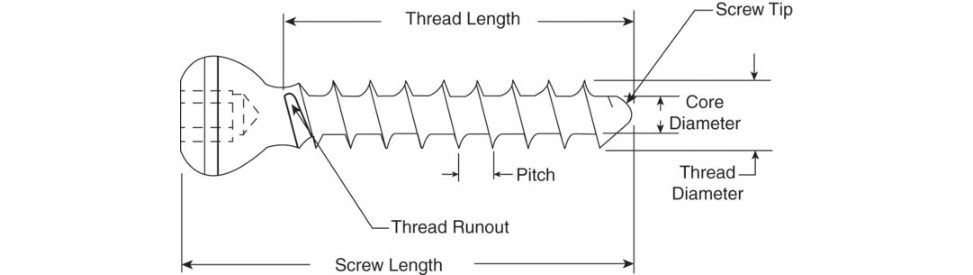
Figure 9.9 Screw terms.
Head
This prevents sinking of the screw into the bone and provides a connection for a screwdriver.
The main slot designs (recess types) for a screwdriver are (1) single slot, (2) cruciate head, (3) Philips,
(4) recessed hexagonal head (hex head) and (5) Torx-6 stardriver (Figure 9.10).
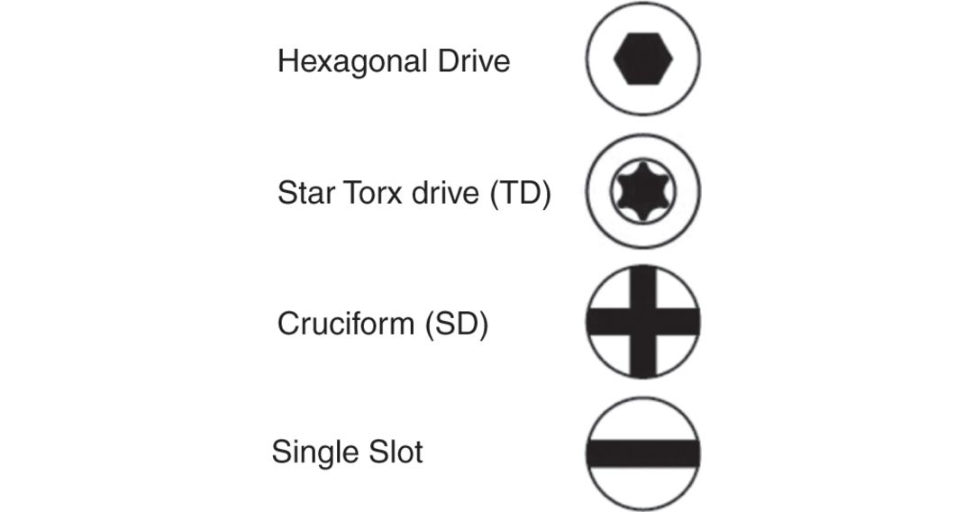
A hexagonal head has six points of contact to increase torque, avoid slip and improve directional control.
Figure 9.10 Slot for screwdriver.
Countersink
The countersink is the undersurface of the head and is either conical or hemispherical.
Runout
Transitional area between shaft and thread. Site of a stress riser and where a screw may break if incorrectly inserted.
Shaft
Smooth link between head and thread. Almost not present in a standard cortical screw.
Thread geometry
This provides a wide surface for pulling and litile frictional resistance on the underside.
Thread pitch
With each full turn the screw advances by a distance equal to the distance between the threads.
Cortical screws have a fine pitch and therefore a greater number of threads. Cancellous screws have a coarse pitch.
A fine-pitched screw moves a smaller distance linearly for a given angular rotation, offers greater mechanical
Thread depth
Thread depth is half the difference between thread diameter and core diameter. The thread depth determines the amount of contact with bone that inturn determines the resistance to pull-out.
Thread shape
The shape of thread may be V-thread (more stress at sharp corner), but iress
Lead
The lead is the linear distance travelled by a screw for one complete (360°) turn of the screw. If a screw is single-threaded, the lead is the same as the pitch.
Diameters
Core diameter: narrowest diameter in the thread section. Solid section from which the threads project outwards. Also, a weak part of a screw.
Sha diameḁter: diameter of shaft where there is no thread.
Outer or Thread diameter: the maximal thread width. The larger the outer diameter, the greater the resistance to pull-out.
Flutes
Channels that provide a route for removal swarf (bone debris).
Tip
Several different designs are available. The tip can be:
Non-self-tapping screw: smooth, conical tip. Needs pr e-drilling of a pilot hole and then use of a tap to create a channel/thread for insertion.
Self-tapping: needs pre-drilling of a pilot hole, but has cuting flutes for creating its own thread/channel
Self-drilling and self-tapping: tip will ma kea drill hole and will cut the channel for the thread.
Corkscrew tip: used in cancellous screws where the tip clears the pre-drilled hole.
Candidates may be stopped at any stage to be more closely questioned on a particular aspect of screw design.
What is the biomechanical definition of a screw?
There are several definitions. A screw is a mechanical device that converts a rotational movement (torque) into a linear movement (translation).
What do we mean by a screw’s purchase?
A screw’s hold in bone is referred to as purchase.
What do we mean by a screw pull-out strength?
The axial force required to remove a screw is referred to as its pull-out strength.
How can you maximize pull-out strength4?
The pull-out strength of a screw can be increased by increasing the contact surface area (interface) between screw threads and bone. This effectively increases the width of the threads. Enough for a 6 pass.
Increasing the number of threads engaged in the bone cortex (increased cortex thickness, bi cortical fixation).
Use a locking screw.
The ‘finer’ the pitch and the more turns the surgeon needs to make to insert the screw and the more turns of the spiral thread engage in a given depth of cortex.
What happens if the pitchis too small?
If the pitchis too small there is insufficient bone between individual threads.
How does the use of a locking screw maximize pull-out strength?
A screw used in a locking plate requires resistance to bending both at the junction between the plate and screw and along the length of the screw. A locking screw as such has a relatively larger core diameter in relation to the thread diameter. This osteosynthesis method is much sturdier compared to sequential pull-out of conventional screws.
What surgeon factors can reduce screw pull-out strength?
Making too large a pilot hole. Wobbling of the screwdriver handle during insertion. Poor technique or technical mistake.
Structured oral examination question 10#
A laminated photograph showing different types of screws (usually cancellous, cortical or cannulated) may be shown to a candidate.
With the standardized viva format the days of candidates being handed over a screw to describe are over.
Describe the different types of screw.
Cortical and cancellous. The main differences relate to: Pitch. Cancellous screws have a larger pitch, greater thread depth and a smaller number of threads. Cancellous screw tips are designed as a tapering spiral. Higher ratio in acor tical screw. Thread depth determines whether a screw is cancellous or cortical. Ratio of inner (c ore) diameter to outer (thread) for a 4.5mm cortical screw is 3/4.5 (66.7%) and for a 4 mm cancellous screw is 1.9/4 (47.5%) ~ 2/3rds to 1/2. Fully or partially threaded screw. A locking screw has threads on the head to allow locking into plates and provide angular stability of the plate screw construct, increasing the pull-out strength of the screw. The hollow core weakens the screw, although clinically this is not often a problem. Guide wire allows radiological check prior to screw insertion.
How do the design features of a particular screw relate to its function?
Cortical screw: acor tical screw is designed to gain maximal purchase in the bone cortices. Cortical bone is usually dense but has limited thickness.
Cancellous screw: this screw is designed to gain purchase in cancellous bone, most commonly the metaphyses of long bones. Cancellous bone isless dense and spread out compared to cortical bone and to gain maximum purchase cancellous screws have wider threads and larger pitch.
The locking screw locks into the plate. The plate/screw construct is more rigid than a non-locking construct and provides greater implant stability.
Cannulated screw: this has a canal through the central core in which a guide wire can be used to guide the position of the screw.
Locking screw (bolt). This is designed to control torsional and axial loads. A large core diameter (strength of screw
What is the technique of lag screw fixation across a fracture site5?
Drilling large lag (gliding) hole (near cortex). Drilling small (threaded) hole (far cortex). Countersinking. Measuring. Taping the far cortex with a protective tap sleeve. Need direction and wobble control. Insertion of screw. Reduction forceps should be removed just before final tightening of the screw. Be sure of your order. For example, if measuring takes place before countersinking then the length of the screw will be too long.
What about fracture reduction?
Normally, the fracture fragments should be reduced before the near cortex is drilled.
What do you mean by countersinking a screw?
When a screw is used without a plate, a countersink hole is created to reduce the risk of fracture as the screw is tightened.
What else?
Failure to countersink can result in very high stresses at the screw head/bone interface, causing microfractures, leading to screw loosening.
What else?
Failure to perform proper countersinking causes an eccentric loading and lessens the degree of compression.
So, what about a small fragment cortical screw, what size is this?
A small fragment screw has a thread diameter of 3.5 mm and a core diameter of 2.5 mm.
What about drill sizes for a lag screw?
3.5-mm drillbit (silver) for the gliding hole and 2.5-mm drillbit (gold) for the thread hole.
Is that for a large or small fragment cortical screw?
Small cortical screw. For a small cortical lag screw the near cortex is drilled with a 3.5-mm drill before the far cortex is drilled with a 2.5-mm
What about a large fragment screw when it is used as a lag screw?
For a large fragment screw this has a thread diameter of 4.5-mm and a core diameter of 3.1- mm. This is score 5/score 6 material. Candidates are not scoring any marks.
What else?
We use a 4.5-mm drillbit for the gliding hole and a 3.2-mm pilot drillbit for the threaded hole.
What size of tap do we use?
The tap is 3.5 mm.
If a candidate mentions using a 4.5-mm drill and a 3.5-mm tap they are heading for a poor fail (score 4) as they don’t understand the principles of lag screw fixation.
How do we measure the depth of the screw tract?
We use a depth gauge.
How?
It is important to engage the hook of the depth gauge against the obtuse edge of the exit hole, not the acute angled edge, otherwise the screw depth will be incorrect.
What about a mini fragment set?
These contain cortical screws of size 1.5 mm and 2.0 mm.
What else?
The 1.5-mm screws are used to fix phalangeal fractures while the 2.0-mm screws are used to fix metacarpal fractures.
Drillbit for gliding hole and threaded hole and tap for a 1.5-mm cortical screw.
I don’t think they are used as a lag screw.
They can be used as a lag screw if needed.
For a 2-mm screw it is 2.0 mm for a gliding hole, 1.5 mm for a threaded hole and a 2-mm tap.
What are the principles of the lag screw technique?
It is a technique, not a type of screw. Any screw can function as a lag screw. It provides interfragmentary compression. The lag screw should compress fracture fragments together.
What are the conditions for interfragmentary compression?
The screw must glide through the near cortex.
Threads hold only in the far cortex.
Screw head should stop at the near cortex.
The maximum compression occurs at 90° to the fracture.
When does the lag screw principle fail?
Sorry, I am not sure what you mean. Lag screws should not be used in comminuted fractures. They should be inserted perpendicular to the fracture plane to generate the greatest interfragmental compression and reduce the risk of fracture displacement.
What are the functions of a scr ew6?
To produce interfragmentary compression. To attach implants to bone, producing angular stability. To lock an intramedullary nail to the cortices. AO teaching.
OK. Can you name me the different types of screw function?
I am not sure. Plate screw: preload and friction is applied to create a force between the plate and the bone. Lag compression screw (see above). Position screw: holds anatomical parts incorrect relation to each other without compression, i.e. thread hole only, no glide. For example, syndesmosis screw.
Anchor screw: a point of fixation used to anchor a wire loop or strong suture. For example, K-wire fixation of medial malleolus fracture.
Push pull screw: a temporary point of fixation used to reduce a fracture by distraction and/or compression.
Reduction screw: a conventional screw is used through a plate to pull fracture fragments
Pollar: screw is used as a fulcrum to redirect/guide an IM nail.
Candidates may be quizzed in more detail on each specific function.
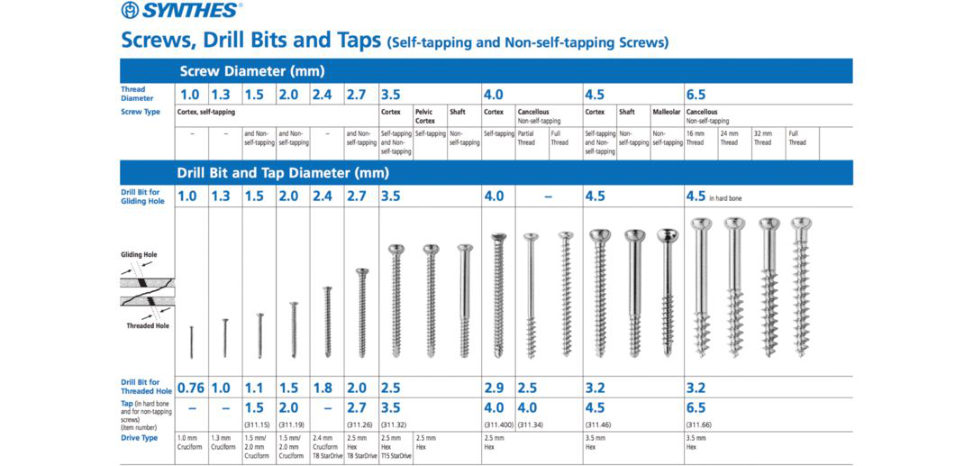
Figure 9.11 Screws, drills, bits and taps.
Structured oral examination question 11#
Screw
The candidate is shown a picture of acor tical screw. What is a screw? What are the parts of the screw?
Why are there different thread diameters? How do you use a lag screw? Why do some screws now have threads in their heads?
Similar question to previous ones, but with a few different twists along the way.
What is a screw?
A screw is a device which converts rotational forces into linear motion [A O definition].
What are the parts of a screw?
A screw has four main functional components. Head. Shaft. Thread. Tip. This is your basic score 5/6 answer. Most candidates should aim to give a bit more detail in their answer to make sure of scoring at least a 6.
What is the difference between thread diameter and thread depth?
The thread depth determines the amount of contact with the bones, which inturn determines the resistance to pull-out. The size of tap is equal to the thread diameter.
How do you use a lag screw7?
A slightly ambiguous question Possibly asking about what fractures are best suited for lag screw fixation
Why do some screws now have threads in their heads?
These are locking screws. They increase screw pull-out strength and prevent sequential pull- out failure of a plate.
Structured oral examination question 12#
Lag screw
Lag screw, principles, how plates work, how nails work. Types of screw. Draw cross-section of a washer. How does a washer work?
How do plates work?
A bone plate transmits forces from one end of the bone to the other bypassing and therefore protecting the area of fracture. It also holds the fracture ends together maintaining alignment while the facture heals.
What factors determine the success of a bone–plate fixation construct?
Cyclical forces above the fatigue limit will eventually lead to plate failure if the fracture does not heal. A race against time for fracture healing versus hardware failure. Locking screws fail en masse. Construct-placement of plate and direction of load. Compression between fragments: always attempt to apply a plate on the tension side of the bone and under compression.
What determines the strength of a plate?
BH3/12 B = base, H = height. Bending stiffness is proportional to the thickness (h) of the plate to the third power.
Why do we use a washer?
Washers spread the load applied by the head on the underlying cortex and are used to prevent the screw head from breaking through a thin cortex [AO]. The y are mainly used in metaphyseal bone or if the bone is osteoporotic.
Draw a cross-section of a washer.
A washer has two sides, a flat side and a concave side. The flat side of the washer rests on the
Structured oral examination question 13#
Design features of a screw
You are given a new screw from a rep. How would you appraise it? What would determine if YOU would consider using it or not?
You are given two types of self-tapping screws (one normal, one reverse-cuting as well as
You are given DC Sand DHS. What are these implants? What are the principles and design specifications of a compression plate?
You have been given a new screw from a company representative How would you appraise it? What would determine if YOU would consider using it or not?
This is similar to the ‘given a new plate by a repand asked to evaluate’. This question is designed to test higher-order thinking. It is one level above a candidate talking through the various functional parts of a screw. What is the material of the screw titanium, stainless steel, bioabsorbable)? Titanium: high tensile and yield strengths, reduced stiffness, increased biocompatibility , Young’s modulus of elasticity closer to bone, diminished stress shielding MRI compatible, superior strength under the high cycle repeated load stresses. Titanium and titanium alloys are not notch-sensitiv e, which means that stress raisers have minimal effects on the mechanical properties of titanium implants. Bioabsorbable: radiolucent, eliminates the need for hardware removal, reduced stress-shielding and allows a gradual load transfer to a healing fracture. Candidates may have a freehand into what screw function they can discuss or be pushed towards one particular direction.
If a screw is not self-tapping it will generally be necessary to use a tap to cut a thread into the bone before screw insertion.
I would want to prevent screw failure and need to consider the following factors. Tensile strength (resistance to bending): this is directly proportional to the square of its core diameter – core diameter2. Torsional strength: proportional to the cube of its core diameter – core diameter3. It is affected by the density of the bone beneath the screw threads. A hemispherical undersurface is generally preferred because it allows a screw to be angulated in all directions within a washer or the screw hole of a plate while maintaining concentric contact between the screw and side of the plate. Score 8: The pull-out strength of a screw increases with increasing screw length, thread diameter, thread depth and bone strength. F = S × (L × π × D) × TSF F = pullout strengthS = ultimate shear strength of bone L = screw length D thread diameter The thread shape factor is defined as 0.5 plus the ratio of thread depth to thread pitch multiplied by a constant TSF = 05 + thread depth/thread pitch × K (constant)
The TS Fand thus screw holding strength increase whenever the thread depth becomes larger (larger threads and smaller root diameter).
Given two types of self-tapping screws (1 normal, one reverse-cuting aswell as self-tapping) – describe these implants. Why would you use a reverse self-cuting screw?
Self-tapping screws are produced with sharp cuting flutes at the leading end of the threaded portion of the screw. The flutes are milled into the thread blank. The flutes cut through bone and facilitate screw insertion. These are called reverse-cuting flutes which allow the thread to cut its way out of the bone after fracture healing.
Can you give me an example of when to use a reverse self-cuting screw?
Reverse self-cuting screws are used to make screw removal easier. The screws are usually self-tapping screws with reverse-cuting flutes .
Given (shown aDCS and DHS implant. What are these implants? Describe their differences. How would you apply them (exactly, with the order of screw placement and why)? What are the principles and design specifications of a compression plate?
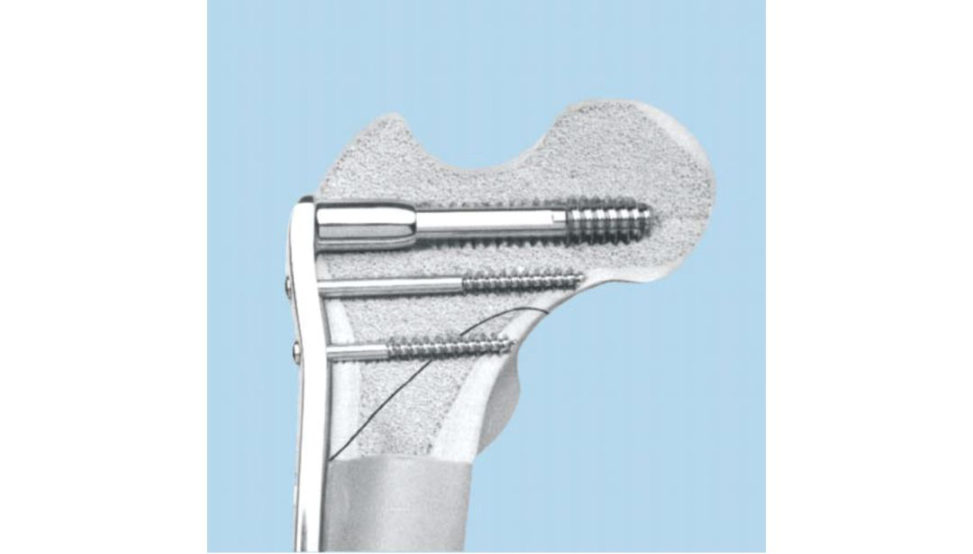
A DCS plate was initially designed for fixation of distal femoral fractures but can also be used to fix proximal femoral fracture sADHS implant is the ‘gold standard’ for intertrochanteric fracture treatment. The main difference between these two implants is the angle of the lag screw with respect to the plate (Figure 9.12). Because the DCS plate has a 95° barrel angle, it does not allow for controlled compression. Using a 135° DHS plate to treat long oblique subtrochanteric fractures does not always allow fracture compression. With the 95° DCS plate stable fixation can be achieved by lagging the fracture through the plate because controlled collapse is not likely to occur.
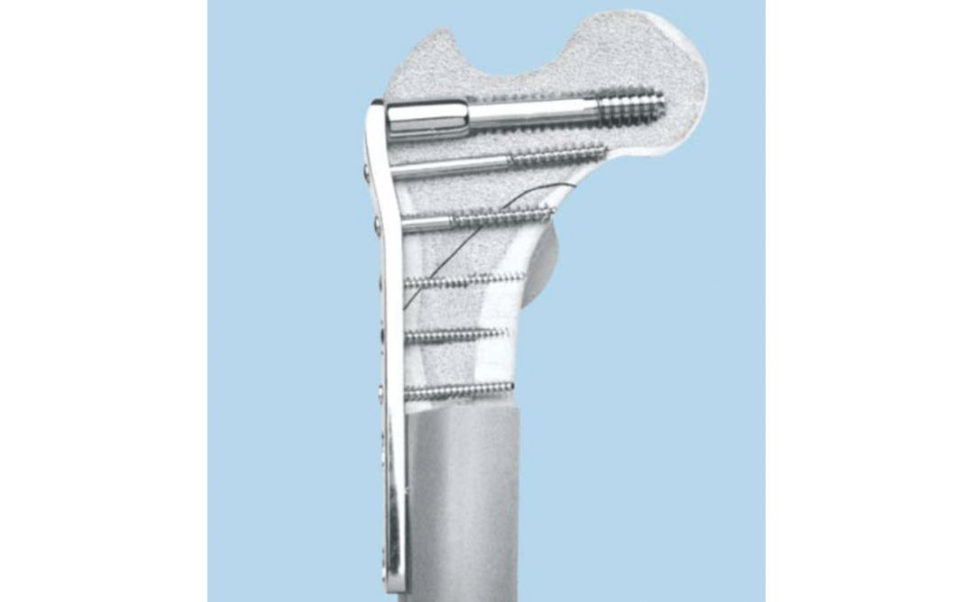
Two 6.5-mm cancellous screws are inserted after lag screw insertion and seating of the plate
(Figure 9.13).
What size of drill do we use?
We drill a hole in the near cortex with a 4.5-mm drillbit. The 4.5/3.2 drill sleeve is fully seated into the plate hole and a 3.2-mm drillbit is used to drill into the far cortex.
What do you mean by the drillbit gliding along the calcar?
Sorry, I am not sure. If a lag screw technique isn’t used the 3.2-mm drillbit will strike the endosteal aspect of the calcar obliquely and be deflected up the neck, where it may break. Th eDHS plate is fixed to the femur using 4.5-mm cortical screws.
When do we use a compression screw?
It allows further fracture impaction. It is useful in unstable fractures to prevent disengagement of the lag screw from the plate barrel.
Are there any concerns with using a compression screw?
A compression screw can cause stripping of the lag screw thread in porotic bone. A void excessive force and remove the compression screw after use.
Why?
I am not sure. A recent paper suggested retaining the compression screw as it helped to lessen mechanical failure of
Figure 9.12 DCS plate for stable subtrochanteric fractures.
Figure 9.13 Insertion of two 6.5-mm cancellous bone screws through the proximal round holes of the DCS plate.
Structured oral examination question 14#
Design features of a plate
Plate design needs a bit of thought and pre-planning because if you are hit blind with this topic in a viva you may struggle and not respond well to questions. It gives the examiners the opportunity to focus in and test your knowledge on various subsections of biomechanics.
Design the perfect plate.
Score 4: I use a z plate because I know it well, the company sales representative is very supportive, we use this plate in our hospital and the company have been very competiv e in their pricing. This question is about principles of plate design and is used to test candidates for higher- order thinking skills. Stay clear of mentioning specific company implants.9 This is in contrast to referring to a cemented Exeter hip implant in a viva. This widely used implant isO DEP 10 A rated with 30 years survivorship results and most trainees are familiar with the kit. These protocols are usually decided through an appropriate local commift ee using a best evidence-based approach.
Constructing an answer
Prepare a simple sentence and then divide your answer into various different headings and then work on the headings.
The design of my implant would require consideration of many factors which would include
1. Material properties
Candidates may end up discussing:
Youngs modulus.
Yield point.
Toughness.
Hardness.
Material properties are independent of shape.
It should be acceptably priced, have corrosion resistance and provide adequate ductility , toughness and hardness.
2. Structural properties
Bending stiffness.
Torsional stiffness.
Axial stiffness.
3. Interface fixation
Locking vs. non-locking plate.
4. Modality of use
Primary healing vs. secondary healing.
Anatomical reduction versus alignment.
Rigid versus relative fixation.
Load-sharing vs. load-bearing.
Combination.
Straight locking vs. variable angle.
Notes
1. Orthobullets, Ryan Eggers, Comment on structural properties.
2. The keywords are ‘a constant volume of material for a fixed length.’
Take hold of a screw and practise out loud naming its various components until flawless.
4. The examiners may stop a candidate half-way through their description of a screw and ask this question.
5. Six steps in the lag screw technique.
6. The examiners may drill down for more detail onto a particular function.
7. The question is abit clums y. Better phrased as when to use a lag screw rather than how to use a lag screw.
8. Chang C-W, Chen Y-N, Li C-T, Peng Y-T, Chang C-H. Med Eng Phys. 2015;37(12):1174–1179.
9. Possibly NCB periprosthetic Zimmer system, as its use is very versatile for difficult complex periprosthetic femoral fractures.